


Teil 2 Sublimation für Anfänger - die ersten Schritte: Die richtige Sublimationstinte



Teil 2 Sublimation für Anfänger - die ersten Schritte: Die richtige Sublimationstinte
Das ist ähnlich wie die Frage - was war zuerst da, das Huhn oder das Ei... um es ganz kurz zu sagen, es gibt keine gute und keine schlechte Tinte. Jede zusammengemixte Sublimationstinte hat so ein paar Stärken und ein paar Schwächen und es kommt auf den Anwender und das benutzte Equipment an, was Er oder Sie oder Divers aus der Tinte herauskitzelt.
Sprüche wie die Tinte taugt nix - sollten nicht hingenommen, sondern hinterfragt werden.
Warum ist der Anwender der sowas sagt mit der Tinte X nicht zurechtgekommen oder zufrieden? Ist es aus mangelnder Kenntnis im Umgang mit dieser entstanden, stand der Anwender am Anfang seiner Sublimationskarriere oder hatte er einfach Pech mit seinem Equipment? Waren vielleicht seine Ungeduld daran Schuld, das er nicht das Optimum aus seiner Tinte herauskitzeln konnte... und und und!
Das ist wie Brot backen - immer die gleichen Zutaten, aber eine andere heran gehensweise und schon hat A etwas anders raus als B.
Den Erfahrungen nach, liegt das Problem zu 99% beim Anwender und mangelnder Kenntnis und/ oder mangelnden aufeinander abgestimmten Equipment oder allem zusammen. Also merke dir, es gibt keine schlechte Sublimationstinte...
Welche Sublimationstinte sollte man verwenden?
(Ein ausführlicher Leitfaden für Einsteiger, Hobbyanwender und Gewerbe – mit einem Augenzwinkern)
Der Sublimationsdruck ist eine faszinierende Technik. Aus einem scheinbar gewöhnlichen Druck wird plötzlich ein dauerhaftes Bild auf Tassen, T-Shirts, Aluminiumplatten oder Mousepads. Für Einsteiger wirkt das fast ein wenig wie Zauberei – und tatsächlich passiert dabei etwas Physikalisches, das ziemlich beeindruckend ist.
Beim Sublimationsdruck wird eine spezielle Tinte unter Hitze gasförmig und verbindet sich dauerhaft mit Polyester oder polymerbeschichteten Materialien. Anders als bei normalen Druckverfahren bleibt die Farbe nicht auf der Oberfläche, sondern dringt in das Material ein. Das Ergebnis: brillante Farben, langlebige Drucke und kein fühlbarer Aufdruck.
Doch bevor die erste Tasse mit dem Gesicht der Lieblingskatze bedruckt wird, steht eine wichtige Frage im Raum:
Welche Sublimationstinte sollte man eigentlich verwenden?
Und genau darum geht es in diesem Artikel.
1. Was ist Sublimationstinte überhaupt?
Normale Druckertinte würde beim Erhitzen einfach verdampfen oder verbrennen. Sublimationstinte dagegen ist speziell dafür entwickelt worden, bei etwa 180–210 °C in einen gasförmigen Zustand überzugehen.
Dieses Gas dringt in Polyesterfasern oder spezielle Beschichtungen ein und wird beim Abkühlen wieder fest – allerdings im Material selbst.
Das hat einige Vorteile:
sehr brillante Farben
kein fühlbarer Druck
hohe Haltbarkeit
waschbeständig bei Textilien
Deshalb findet Sublimation besonders häufig Anwendung bei:
Textilien mit Polyesteranteil
Tassen und Bechern
Aluminiumplatten
Handyhüllen
Mousepads
Fliesen
Werbeartikeln aller Art
Moderne Sublimationstinten – wie beispielsweise die Marke German Ink Company (GIC) – liefern dabei besonders hohe Farbdichten und einen großen Farbraum für kräftige Farben.
2. Welche Sublimationstinte sollte man wählen?
Der Markt für Sublimationstinte ist inzwischen riesig. Von sehr günstigen No-Name-Produkten aus Fernost bis hin zu etablierten Marken ist alles vertreten.
Doch beim Kauf sollte man sich ein paar wichtige Fragen stellen.
2.1 Kompatibilität mit dem Drucker
Der wichtigste Punkt zuerst:
Nicht jeder Drucker kann Sublimation.
Die meisten Sublimationstinten sind für Piezo-Druckköpfe entwickelt worden. Diese findet man vor allem bei Druckern von:
Epson
Brother
Ricoh
Mimaki
Roland
Mutoh
Piezo-Druckköpfe können die Tinte mechanisch ausstoßen – ohne Hitze. Das ist wichtig, weil Sublimationstinte temperaturanfällig ist.
Thermaldruckköpfe (z. B. HP- oder Canon-Modelle) sind aktuell nicht geeignet.
2.2 Farbbrillanz
Ein gutes Sublimationssystem erkennt man an:
hoher Farbdichte
großem Farbraum
sauberen Farbverläufen
Billige Tinten haben hier oft Probleme. Typische Symptome sind:
blasse Farben
falsche Farbtöne
schlechte Schwarztöne
Farbstich (z. B. Rot wird Orange)
Kurz gesagt:
Die Katze auf der Tasse sieht plötzlich aus wie ein Sonnenuntergang.
2.3 Zuverlässigkeit und Druckkopfverträglichkeit
Eine gute Sublimationstinte sollte:
nicht verstopfen
gleichmäßig fließen
lange lagerfähig sein
Gerade bei sehr günstigen Tinten kann es passieren, dass:
Düsen schneller verstopfen
Druckköpfe verschleißen
Farbpartikel sich absetzen
Das kann auf Dauer teurer werden als eine hochwertige Tinte.
3. Warum GIC (German Ink Company) zu den führenden Marken zählt
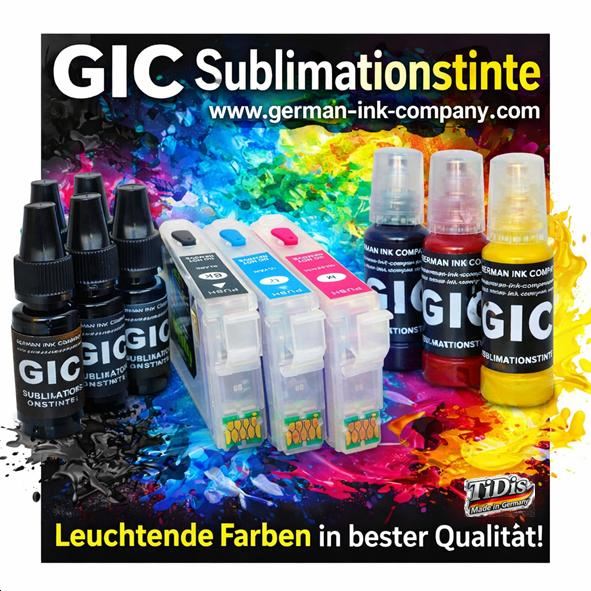
Eine der bekanntesten Sublimationstinten aus Deutschland ist die Marke German Ink Company (GIC).
Diese Tinte wird unter anderem vom Berliner Handelshaus TiDis vertrieben und hat sich in den letzten Jahren sowohl im Hobbybereich als auch im professionellen Einsatz etabliert.
Die Gründe dafür sind relativ einfach:
Hohe Farbbrillanz
Die Tinte bietet eine sehr hohe Farbdichte und einen großen Farbraum. Dadurch entstehen besonders kräftige und natürliche Farben.
Sehr gute Laufeigenschaften
GIC ist so formuliert, dass sie gleichmäßig durch den Druckkopf fließt und auch bei höheren Druckgeschwindigkeiten stabil arbeitet.
Vielseitigkeit
Die Tinte eignet sich für:
Textilien
Keramik
Metall
beschichtete Materialien
und wird sowohl im Heimdruck als auch in der Werbetechnik eingesetzt.
Große Verbreitung
Die Marke hat sich seit Jahren im Markt etabliert und wird in vielen Werkstätten, Druckereien und DIY-Projekten genutzt.
Oder anders gesagt:
Wenn Sublimation eine Fußballliga wäre, würde GIC definitiv in der ersten Liga spielen – nicht auf der Ersatzbank.
4. Braucht man ein ICC-Profil?
Hier kommen wir zu einem Thema, das viele Einsteiger zunächst verwirrt:
ICC-Profile
Keine Sorge – das ist weniger kompliziert, als es klingt.
Was ist ein ICC-Profil?
Ein ICC-Profil ist ein Datensatz, der beschreibt, wie ein Gerät Farben darstellt oder druckt. Es sorgt dafür, dass Farben möglichst genau wiedergegeben werden.
Das Ziel ist:
Was du auf dem Monitor siehst, soll auch ungefähr so auf der Tasse landen.
Ohne ICC-Profil kann folgendes passieren:
Rot wird orange
Blau wird lila
Hauttöne sehen aus wie Karotten
Und spätestens dann fragt man sich:
"Warum sieht meine Tasse aus, als hätte sie Sonnenbrand?"
Warum sind ICC-Profile wichtig?
Jede Kombination ist unterschiedlich:
Drucker
Sublimationstinte
Papier
Material
Ein ICC-Profil gleicht diese Unterschiede aus.
Viele Anbieter stellen daher passende Profile für ihre Tinten bereit, die auf bestimmte Drucker abgestimmt sind.
Muss man unbedingt eines verwenden?
Die ehrliche Antwort:
Nein – aber es hilft enorm.
Gerade für:
Einsteiger
DIY-Projekte
kleine Gewerbe
kann ein ICC-Profil den Unterschied zwischen:
👉 „Okay“
und
👉 „Wow!“
machen.
5. Unterschied zwischen Endverbraucher und gewerblicher Nutzung
Auch hier gibt es einen wichtigen Unterschied.
Endverbraucher (Hobby / DIY)
Typische Anwendungen:
Geschenkartikel
Tassen für Familie
T-Shirts
kleine Bastelprojekte
Anforderungen:
einfache Bedienung
günstige Kosten
gute, aber nicht perfekte Farbgenauigkeit
Hier reicht oft:
ein umgebauter Epson-EcoTank
gute Sublimationstinte
ein universelles ICC-Profil
Und wenn die Farbe der Tasse minimal vom Bildschirm abweicht?
Nun ja – die Schwiegermutter wird es vermutlich trotzdem mögen.
Gewerbliche Nutzung
Im professionellen Bereich gelten andere Regeln.
Typische Anwendungen:
Werbeartikelproduktion
Textildruck
Merchandising
Personalisierte Produkte im Onlinehandel
Hier sind wichtig:
exakte Farbtreue
Wiederholbarkeit
hohe Produktionsgeschwindigkeit
Ein Unternehmen muss sicherstellen, dass:
Tasse Nr. 1
Tasse Nr. 100
Tasse Nr. 10 000
immer gleich aussehen.
Deshalb werden hier oft verwendet:
speziell abgestimmte ICC-Profile
hochwertige Sublimationstinten
professionelle Drucker
standardisierte Prozesse
6. Typische Anfängerfehler
Hier eine kleine Liste der Klassiker:
1. Billigste Tinte kaufen
Spart vielleicht 10 €, kostet später aber Nerven.
2. Falsches Papier verwenden
Papier ist genauso wichtig wie Tinte.
3. Kein ICC-Profil
Dann wundert man sich über Karottenfarben.
4. Zu niedrige Temperatur
Dann sublimiert die Tinte nicht richtig.
5. Falsches Material
Sublimation funktioniert nur mit Polyester oder Beschichtung.
Ein Baumwollshirt ohne Beschichtung bleibt leider…
ein Baumwollshirt ohne Druck.
7. Fazit
Die Wahl der richtigen Sublimationstinte entscheidet maßgeblich über die Qualität deiner Drucke.
Worauf sollte man achten?
Kompatibilität mit dem Drucker
gute Farbbrillanz
zuverlässige Druckeigenschaften
passende ICC-Profile
Marken wie German Ink Company (GIC) haben sich dabei als hochwertige Lösung etabliert und werden sowohl im Hobbybereich als auch im professionellen Einsatz verwendet.
Ein gutes ICC-Profil kann zusätzlich helfen, Farben präzise darzustellen und konstant gute Ergebnisse zu erzielen.
Und wenn am Ende alles funktioniert, passiert das, was beim Sublimationsdruck immer wieder für Begeisterung sorgt:
Man zieht die Transferfolie von der Tasse ab –
und denkt sich:
„Moment mal… habe ich das gerade wirklich selbst gedruckt?“
Spoiler:
Ja.
Und beim nächsten Mal wird es noch besser.

Also wenn du eine Tinte suchst die auch richtig schwarz drucken kann, dann ist die GIC Sublimationstinte deine Sublimationstinte.
Mit dem passenden GIC Papier und einen brauchbaren Drucker erzielst du die Ergebnisse die du dir wünscht.
Wenn nicht, hast du was falsch gemacht oder dein Equipment ist fehlerhaft und du könntest dich bei unserer Technik melden.
Mail an Info@tidis.de
Und wenn mal nicht, dann probiere es später noch einmal.

Which Sublimation Ink Should You Use?
(A detailed guide for beginners, hobby users, and businesses – with a little humor)
Sublimation printing is a fascinating technology. What initially looks like an ordinary print suddenly becomes a permanent image on mugs, T-shirts, aluminum panels, or mouse pads. For beginners, it almost feels like magic – and in a way, something pretty impressive is actually happening.
In sublimation printing, a special ink turns into gas under heat and permanently bonds with polyester or polymer-coated materials. Unlike normal printing methods, the color does not remain on the surface but becomes part of the material itself. The result: brilliant colors, durable prints, and no noticeable texture.
But before you print your first mug featuring your favorite cat (or your company logo), an important question arises:
Which sublimation ink should you actually use?
That’s exactly what this guide is about.
1. What Is Sublimation Ink?
Normal printer ink would simply evaporate or burn when exposed to the high temperatures used in sublimation printing. Sublimation ink, however, is specially designed to transform into a gaseous state at around 180–210 °C (356–410 °F).
This gas penetrates polyester fibers or special coatings and becomes solid again as it cools – but this time inside the material.
This provides several advantages:
very vibrant colors
no raised print surface
extremely durable results
wash resistance for textiles
Because of these properties, sublimation is commonly used for:
polyester textiles
mugs and cups
aluminum plates
phone cases
mouse pads
tiles
promotional products
Modern sublimation inks – such as those from German Ink Company (GIC) – provide particularly strong color density and a wide color gamut for bright, vivid prints.
2. Which Sublimation Ink Should You Choose?
The sublimation ink market has grown enormously in recent years. Everything from very cheap no-name products to well-known premium brands is available.
When choosing an ink, you should consider several important factors.
2.1 Printer Compatibility
First and foremost:
Not every printer can handle sublimation ink.
Most sublimation inks are designed for piezo printheads, which are commonly found in printers from manufacturers such as:
Epson
Brother
Ricoh
Mimaki
Roland
Mutoh
Piezo printheads push ink out mechanically rather than using heat. This is important because sublimation ink is sensitive to temperature.
Thermal printheads (used in many HP or Canon printers) are often less suitable.
2.2 Color Brilliance
A good sublimation ink can usually be recognized by:
strong color density
wide color gamut
smooth gradients
Cheaper inks often struggle here. Typical problems include:
faded colors
inaccurate tones
weak blacks
color shifts (for example, red appearing orange)
In short:
The cute cat you printed on the mug suddenly looks like a sunset.
2.3 Reliability and Printhead Safety
A high-quality sublimation ink should:
flow smoothly
avoid clogging
remain stable over time
With very cheap inks, you might encounter:
clogged nozzles
faster printhead wear
pigment settling
In the long run, that can become more expensive than buying a high-quality ink in the first place.
3. Why GIC (German Ink Company) Is Considered a Leading Brand
One of the best-known sublimation ink brands from Germany is German Ink Company (GIC).
Distributed by the Berlin-based supplier TiDis, this ink has become well established in both hobby and professional printing environments.
There are several reasons for this.
Excellent Color Brilliance
The ink offers high color density and a wide color gamut, producing vivid and natural-looking prints.
Very Good Printing Performance
GIC inks are formulated to flow smoothly through printheads and maintain stability even during faster printing processes.
Versatility
The ink is suitable for many materials, including:
textiles
ceramics
metal
polymer-coated products
Wide Market Adoption
The brand has become widely used in workshops, printing businesses, and DIY sublimation setups.
Or in simpler terms:
If sublimation inks were part of a sports league, GIC would definitely be playing in the first division – not sitting on the bench.
4. Do You Need an ICC Profile?
Now we come to a topic that often confuses beginners:
ICC profiles
Don’t worry – it sounds more technical than it really is.
What Is an ICC Profile?
An ICC profile is a set of data that describes how a device reproduces colors.
Its purpose is simple:
The colors you see on your monitor should look as similar as possible when printed.
Without an ICC profile, things can go wrong quickly:
red may turn orange
blue may appear purple
skin tones might look like carrots
And at that point you might wonder:
“Why does my mug look like it got a sunburn?”
Why ICC Profiles Matter
Every sublimation setup is different:
printer
sublimation ink
transfer paper
substrate
An ICC profile compensates for these differences.
Many suppliers therefore provide custom profiles designed specifically for their inks and certain printer models.
Do You Really Need One?
The honest answer is:
No – but it helps a lot.
Especially for:
beginners
hobby printing
small businesses
An ICC profile can be the difference between:
👉 “Looks okay”
and
👉 “Wow, that looks amazing!”
5. Difference Between Consumer and Commercial Use
There is also a significant difference between hobby users and professional users.
Consumer / Hobby Use
Typical applications include:
personalized gifts
mugs for family and friends
T-shirts
DIY projects
Priorities usually include:
simple setup
low cost
decent but not perfect color accuracy
In many cases, a converted Epson EcoTank printer, good sublimation ink, and a universal ICC profile are sufficient.
And if the mug color is slightly different from what you saw on screen?
Well… your mother-in-law will probably still like the gift.
Commercial Use
Professional production has very different requirements.
Typical applications include:
promotional product manufacturing
textile printing businesses
merchandise production
personalized products for online shops
Important factors here include:
precise color accuracy
consistent results
high production speed
Companies must ensure that:
mug number 1
mug number 100
mug number 10,000
all look exactly the same.
That is why professional setups often use:
custom ICC profiles
high-quality sublimation inks
professional printers
standardized workflows
6. Typical Beginner Mistakes
Here are some of the most common ones:
Buying the Cheapest Ink
You might save €10 today, but lose your patience later.
Using the Wrong Paper
Transfer paper is just as important as the ink.
Skipping the ICC Profile
That’s when your colors start turning into vegetables.
Too Little Heat
If the temperature is too low, the ink will not sublimate properly.
Wrong Material
Sublimation works only with polyester or coated materials.
A cotton T-shirt without coating will remain…
a cotton T-shirt without a print.
7. Conclusion
Choosing the right sublimation ink plays a crucial role in the quality of your prints.
Key factors to consider include:
compatibility with your printer
color brilliance
reliable printing performance
availability of ICC profiles
Brands such as German Ink Company (GIC) have established themselves as high-quality options used by both hobby users and professional printing businesses.
Using a suitable ICC profile can further improve color accuracy and ensure consistent results.
And when everything works perfectly, you experience the moment that makes sublimation printing so exciting:
You peel the transfer paper off the mug…
look at the result…
and think:
“Wait… did I really just print this myself?”
Spoiler alert:
Yes, you did.
And the next one will look even better.
Quelle encre de sublimation choisir ?
(Un guide détaillé pour les débutants, les amateurs et les professionnels – avec une touche d’humour)
L’impression par sublimation est une technologie fascinante. Ce qui ressemble au départ à une impression ordinaire devient soudainement une image permanente sur des mugs, des t-shirts, des plaques en aluminium ou des tapis de souris. Pour les débutants, cela peut presque ressembler à de la magie – et en réalité, il se passe effectivement quelque chose d’assez impressionnant.
Dans l’impression par sublimation, une encre spéciale devient gazeuse sous l’effet de la chaleur et se fixe de manière permanente sur des fibres de polyester ou des surfaces recouvertes d’un polymère. Contrairement aux méthodes d’impression classiques, la couleur ne reste pas à la surface : elle pénètre dans le matériau lui-même.
Le résultat : des couleurs éclatantes, une impression durable et aucune sensation de relief.
Mais avant d’imprimer votre premier mug avec la photo de votre chat préféré (ou le logo de votre entreprise), une question importante se pose :
Quelle encre de sublimation faut-il utiliser ?
C’est précisément l’objectif de cet article.
1. Qu’est-ce que l’encre de sublimation ?
Une encre d’imprimante classique brûlerait ou s’évaporerait simplement aux températures élevées utilisées pour la sublimation. L’encre de sublimation, en revanche, est spécialement conçue pour se transformer en gaz à environ 180–210 °C.
Ce gaz pénètre dans les fibres de polyester ou dans les revêtements spéciaux et redevient solide en refroidissant – mais à l’intérieur du matériau.
Cela offre plusieurs avantages :
couleurs très vives
aucun relief au toucher
impressions extrêmement durables
résistance au lavage pour les textiles
C’est pourquoi la sublimation est souvent utilisée pour :
textiles en polyester
mugs et tasses
plaques en aluminium
coques de téléphone
tapis de souris
carreaux décoratifs
objets publicitaires
Les encres de sublimation modernes – comme celles de German Ink Company (GIC) – offrent une densité de couleur élevée et une large gamme de couleurs pour des impressions particulièrement brillantes.
2. Quelle encre de sublimation choisir ?
Le marché des encres de sublimation est devenu très vaste. On trouve aujourd’hui tout, des produits très bon marché sans marque aux encres haut de gamme bien établies.
Avant de choisir une encre, il est important de prendre en compte plusieurs critères.
2.1 Compatibilité avec l’imprimante
Le point le plus important :
Toutes les imprimantes ne sont pas adaptées à la sublimation.
La plupart des encres de sublimation sont conçues pour des têtes d’impression piezo, que l’on trouve notamment dans les imprimantes de marques comme :
Epson
Brother
Ricoh
Mimaki
Roland
Mutoh
Ces têtes d’impression expulsent l’encre mécaniquement, sans utiliser de chaleur. Cela est essentiel, car l’encre de sublimation est sensible à la température.
Les têtes d’impression thermiques (présentes dans de nombreux modèles HP ou Canon) sont généralement moins adaptées.
2.2 Brillance des couleurs
Une bonne encre de sublimation se reconnaît généralement à :
une forte densité de couleur
une large gamme de couleurs
des dégradés doux et propres
Les encres bon marché présentent souvent certains problèmes :
couleurs fades
teintes incorrectes
noirs peu profonds
dérives de couleur (par exemple, un rouge qui devient orange)
En résumé :
Le joli chat imprimé sur votre mug ressemble soudainement à un coucher de soleil.
2.3 Fiabilité et protection de la tête d’impression
Une encre de sublimation de qualité doit :
s’écouler facilement
éviter l’obstruction des buses
rester stable dans le temps
Les encres très bon marché peuvent entraîner :
des buses bouchées
une usure plus rapide de la tête d’impression
un dépôt de pigments
À long terme, cela peut coûter bien plus cher que d’acheter une bonne encre dès le départ.
3. Pourquoi GIC (German Ink Company) fait partie des marques leaders
L’une des encres de sublimation les plus connues en Allemagne est German Ink Company (GIC).
Distribuée notamment par le fournisseur berlinois TiDis, cette encre s’est imposée aussi bien dans les ateliers d’impression professionnels que chez les amateurs.
Plusieurs raisons expliquent ce succès.
Excellente brillance des couleurs
L’encre offre une densité de couleur élevée et une large gamme chromatique, ce qui permet d’obtenir des impressions particulièrement éclatantes et naturelles.
Très bonnes performances d’impression
Les encres GIC sont formulées pour circuler de manière fluide dans les têtes d’impression et rester stables même lors d’impressions rapides.
Polyvalence
Cette encre peut être utilisée sur de nombreux supports :
textiles
céramique
métal
matériaux avec revêtement polymère
Large adoption sur le marché
La marque est aujourd’hui utilisée dans de nombreux ateliers, entreprises d’impression et projets DIY.
Autrement dit :
Si les encres de sublimation jouaient dans une ligue sportive, GIC serait clairement en première division – et certainement pas sur le banc des remplaçants.
4. Faut-il un profil ICC ?
Un sujet qui intrigue souvent les débutants est celui des profils ICC.
Pas de panique : c’est plus simple qu’il n’y paraît.
Qu’est-ce qu’un profil ICC ?
Un profil ICC est un fichier qui décrit la manière dont un appareil reproduit les couleurs.
Son objectif est simple :
Les couleurs affichées sur votre écran doivent être aussi proches que possible de celles imprimées.
Sans profil ICC, plusieurs problèmes peuvent apparaître :
le rouge devient orange
le bleu devient violet
les tons de peau ressemblent à des carottes
Et à ce moment-là, on se demande :
« Pourquoi mon mug a-t-il l’air d’avoir pris un coup de soleil ? »
Pourquoi les profils ICC sont importants
Chaque système de sublimation est différent :
imprimante
encre
papier de transfert
support
Un profil ICC permet de compenser ces différences.
C’est pourquoi de nombreux fournisseurs proposent des profils adaptés à leurs encres et à certains modèles d’imprimantes.
Est-ce vraiment indispensable ?
La réponse honnête est :
Non – mais c’est très utile.
Surtout pour :
les débutants
les projets de loisirs
les petites entreprises
Un profil ICC peut faire la différence entre :
👉 « Pas mal »
et
👉 « Waouh, c’est magnifique ! »
5. Différence entre usage domestique et usage professionnel
Il existe également une différence importante entre les utilisateurs amateurs et les professionnels.
Utilisation domestique / loisirs
Applications typiques :
cadeaux personnalisés
mugs pour la famille
t-shirts
projets DIY
Les priorités sont généralement :
simplicité d’utilisation
coûts faibles
précision des couleurs correcte mais pas parfaite
Dans beaucoup de cas, un Epson EcoTank converti, une bonne encre de sublimation et un profil ICC standard suffisent.
Et si la couleur du mug diffère légèrement de celle de l’écran ?
Eh bien… votre belle-mère appréciera probablement quand même le cadeau.
Utilisation professionnelle
Dans un environnement professionnel, les exigences sont bien plus élevées.
Applications typiques :
production d’objets publicitaires
impression textile
merchandising
produits personnalisés pour boutiques en ligne
Les critères essentiels sont :
précision des couleurs
reproductibilité
vitesse de production élevée
Une entreprise doit pouvoir garantir que :
le mug numéro 1
le mug numéro 100
le mug numéro 10 000
sont parfaitement identiques.
C’est pourquoi les professionnels utilisent souvent :
des profils ICC personnalisés
des encres de sublimation de haute qualité
des imprimantes professionnelles
des processus standardisés
6. Les erreurs les plus fréquentes des débutants
Voici quelques classiques :
Acheter l’encre la moins chère
Vous économisez peut-être 10 €, mais vous perdez beaucoup de patience.
Utiliser le mauvais papier
Le papier de transfert est aussi important que l’encre.
Ignorer le profil ICC
Et soudain vos couleurs ressemblent à des légumes.
Température trop basse
Si la chaleur est insuffisante, l’encre ne sublime pas correctement.
Mauvais matériau
La sublimation fonctionne uniquement avec du polyester ou des surfaces revêtues.
Un t-shirt en coton sans revêtement restera…
un t-shirt en coton sans impression.
7. Conclusion
Le choix de la bonne encre de sublimation influence fortement la qualité de vos impressions.
Les points importants à considérer sont :
compatibilité avec l’imprimante
brillance des couleurs
fiabilité de l’encre
disponibilité de profils ICC
Des marques comme German Ink Company (GIC) se sont imposées comme des solutions fiables utilisées aussi bien par les amateurs que par les professionnels.
L’utilisation d’un profil ICC adapté peut améliorer encore la précision des couleurs et garantir des résultats constants.
Et lorsque tout fonctionne parfaitement, on vit ce moment magique propre à la sublimation :
On retire le papier de transfert du mug…
on regarde le résultat…
et on se dit :
« Attends… c’est vraiment moi qui ai imprimé ça ? »
Spoiler :
Oui.
Et la prochaine impression sera encore meilleure.
Qué tinta de sublimación deberías utilizar?
(Una guía detallada para principiantes, aficionados y empresas – con un toque de humor)
La impresión por sublimación es una tecnología fascinante. Lo que al principio parece una impresión normal de repente se convierte en una imagen permanente sobre tazas, camisetas, placas de aluminio o alfombrillas de ratón. Para los principiantes, casi parece magia… y en cierto modo lo es.
En la impresión por sublimación, una tinta especial se convierte en gas cuando se aplica calor y se fija permanentemente a fibras de poliéster o a superficies con recubrimiento de polímero. A diferencia de otros métodos de impresión, el color no permanece en la superficie, sino que se integra dentro del material.
El resultado: colores brillantes, impresiones duraderas y sin relieve perceptible.
Pero antes de imprimir tu primera taza con la foto de tu mascota favorita (o con el logotipo de tu empresa), surge una pregunta importante:
¿Qué tinta de sublimación deberías utilizar realmente?
De eso trata exactamente este artículo.
1. ¿Qué es la tinta de sublimación?
La tinta de impresora normal simplemente se evaporaría o se quemaría con las altas temperaturas utilizadas en la sublimación. La tinta de sublimación, en cambio, está especialmente diseñada para transformarse en gas a aproximadamente 180–210 °C.
Ese gas penetra en las fibras de poliéster o en recubrimientos especiales y vuelve a solidificarse al enfriarse… pero dentro del material.
Esto ofrece varias ventajas:
colores muy intensos
sin relieve al tacto
impresiones muy duraderas
resistencia al lavado en textiles
Por esta razón, la sublimación se utiliza con frecuencia para:
textiles de poliéster
tazas y mugs
placas de aluminio
fundas para teléfonos
alfombrillas de ratón
azulejos decorativos
artículos promocionales
Las tintas de sublimación modernas —como las de German Ink Company (GIC)— ofrecen una alta densidad de color y una amplia gama cromática para obtener impresiones especialmente vibrantes.
2. ¿Qué tinta de sublimación elegir?
El mercado de la tinta de sublimación ha crecido enormemente en los últimos años. Hoy en día existe desde tinta muy barata sin marca hasta productos de alta calidad de fabricantes reconocidos.
Al elegir una tinta, es importante tener en cuenta varios factores.
2.1 Compatibilidad con la impresora
El punto más importante:
No todas las impresoras son adecuadas para sublimación.
La mayoría de las tintas de sublimación están diseñadas para cabezales de impresión piezoeléctricos, que se encuentran especialmente en impresoras de marcas como:
Epson
Brother
Ricoh
Mimaki
Roland
Mutoh
Estos cabezales expulsan la tinta mecánicamente y no mediante calor, lo cual es importante porque la tinta de sublimación es sensible a la temperatura.
Los cabezales térmicos (presentes en muchas impresoras HP o Canon) suelen ser menos adecuados.
2.2 Brillo y calidad del color
Una buena tinta de sublimación suele caracterizarse por:
alta densidad de color
amplia gama cromática
degradados suaves
Las tintas más baratas suelen presentar problemas como:
colores apagados
tonos incorrectos
negros débiles
desviaciones de color (por ejemplo, rojo que se vuelve naranja)
En pocas palabras:
El adorable gato que imprimiste en la taza de repente parece un atardecer.
2.3 Fiabilidad y cuidado del cabezal de impresión
Una tinta de sublimación de buena calidad debería:
fluir de manera uniforme
evitar obstrucciones
mantener estabilidad con el tiempo
Las tintas muy baratas pueden provocar:
boquillas obstruidas
desgaste más rápido del cabezal
sedimentación de pigmentos
A largo plazo, eso puede resultar más caro que comprar una tinta de mayor calidad desde el principio.
3. Por qué GIC (German Ink Company) es una de las marcas líderes
Una de las tintas de sublimación más conocidas procedentes de Alemania es German Ink Company (GIC).
Esta tinta es distribuida, entre otros, por el proveedor berlinés TiDis y se ha establecido tanto en el ámbito doméstico como en el profesional.
Las razones son bastante claras.
Excelente intensidad de color
La tinta ofrece una alta densidad de color y una amplia gama cromática, lo que permite obtener impresiones muy vivas y naturales.
Muy buen rendimiento de impresión
Las tintas GIC están formuladas para fluir de forma uniforme a través del cabezal de impresión y mantenerse estables incluso durante trabajos de impresión más rápidos.
Gran versatilidad
La tinta se puede utilizar en muchos materiales, por ejemplo:
textiles
cerámica
metal
materiales con recubrimiento de polímero
Amplia presencia en el mercado
La marca se utiliza en numerosos talleres, empresas de impresión y proyectos de sublimación DIY.
En otras palabras:
Si las tintas de sublimación fueran una liga deportiva, GIC estaría claramente en primera división… y no sentada en el banquillo.
4. ¿Es necesario un perfil ICC?
Un tema que suele confundir a los principiantes es el de los perfiles ICC.
Pero no te preocupes: es más sencillo de lo que parece.
¿Qué es un perfil ICC?
Un perfil ICC es un archivo que describe cómo un dispositivo reproduce los colores.
Su objetivo es simple:
Que los colores que ves en tu pantalla sean lo más parecidos posible a los que se imprimen.
Sin un perfil ICC pueden ocurrir cosas curiosas:
el rojo se vuelve naranja
el azul se vuelve violeta
los tonos de piel parecen zanahorias
Y en ese momento uno se pregunta:
“¿Por qué mi taza parece que tiene una quemadura de sol?”
Por qué son importantes los perfiles ICC
Cada sistema de sublimación es diferente:
impresora
tinta
papel de transferencia
material
Un perfil ICC compensa esas diferencias.
Por eso muchos proveedores ofrecen perfiles específicos para sus tintas y determinados modelos de impresora.
¿Es realmente necesario?
La respuesta honesta es:
No, pero ayuda muchísimo.
Especialmente para:
principiantes
aficionados
pequeñas empresas
Un perfil ICC puede marcar la diferencia entre:
👉 “Está bien”
y
👉 “¡Wow, qué bien se ve!”
5. Diferencia entre uso doméstico y uso profesional
También hay una gran diferencia entre usuarios domésticos y profesionales.
Uso doméstico / hobby
Aplicaciones típicas:
regalos personalizados
tazas para la familia
camisetas
proyectos DIY
Las prioridades suelen ser:
facilidad de uso
bajo coste
buena calidad, aunque no perfecta
En muchos casos basta con:
una Epson EcoTank convertida
buena tinta de sublimación
un perfil ICC estándar
Y si el color de la taza no coincide exactamente con el de la pantalla…
Bueno… probablemente a tu suegra le seguirá gustando el regalo.
Uso profesional
En el ámbito profesional los requisitos son mucho más altos.
Aplicaciones típicas:
producción de artículos promocionales
impresión textil
merchandising
productos personalizados para tiendas online
Aquí son importantes:
precisión del color
consistencia
alta velocidad de producción
Una empresa debe garantizar que:
la taza número 1
la taza número 100
la taza número 10 000
tengan exactamente el mismo aspecto.
Por eso los profesionales suelen utilizar:
perfiles ICC personalizados
tintas de sublimación de alta calidad
impresoras profesionales
procesos de producción estandarizados
6. Errores típicos de principiantes
Algunos de los más comunes son:
Comprar la tinta más barata
Quizá ahorres 10 €, pero perderás paciencia después.
Usar el papel equivocado
El papel de transferencia es tan importante como la tinta.
No usar perfil ICC
Entonces los colores empiezan a parecer verduras.
Temperatura demasiado baja
Si la temperatura es demasiado baja, la tinta no se sublimará correctamente.
Material incorrecto
La sublimación funciona solo con poliéster o materiales con recubrimiento.
Una camiseta de algodón sin recubrimiento seguirá siendo…
una camiseta de algodón sin impresión.
7. Conclusión
Elegir la tinta de sublimación adecuada influye directamente en la calidad de tus impresiones.
Los aspectos más importantes a tener en cuenta son:
compatibilidad con la impresora
brillo y calidad del color
fiabilidad de la tinta
disponibilidad de perfiles ICC
Marcas como German Ink Company (GIC) se han consolidado como soluciones de alta calidad utilizadas tanto por aficionados como por profesionales.
El uso de un perfil ICC adecuado puede mejorar aún más la precisión del color y garantizar resultados consistentes.
Y cuando todo funciona perfectamente, llega ese momento especial que hace tan emocionante la sublimación:
Quitas el papel de transferencia de la taza…
miras el resultado…
y piensas:
“Espera… ¿de verdad he impreso esto yo?”
Spoiler:
Sí.
Y la próxima impresión será aún mejor.
Quale inchiostro per sublimazione dovresti utilizzare?
(Una guida dettagliata per principianti, hobbisti e aziende – con un pizzico di umorismo)
La stampa a sublimazione è una tecnologia affascinante. Quello che inizialmente sembra una normale stampa si trasforma improvvisamente in un’immagine permanente su tazze, magliette, pannelli in alluminio o tappetini per mouse. Per chi inizia, può sembrare quasi magia – e in un certo senso lo è davvero.
Nella stampa a sublimazione, un inchiostro speciale diventa gassoso quando viene riscaldato e si lega permanentemente alle fibre di poliestere o alle superfici con rivestimento polimerico. A differenza dei metodi di stampa tradizionali, il colore non rimane sulla superficie, ma entra nel materiale stesso.
Il risultato: colori brillanti, stampe molto resistenti e nessuna sensazione di rilievo.
Ma prima di stampare la tua prima tazza con la foto del tuo animale domestico preferito (o con il logo della tua azienda), sorge una domanda importante:
Quale inchiostro per sublimazione dovresti scegliere?
Ed è proprio questo l’argomento di questo articolo.
1. Che cos’è l’inchiostro per sublimazione?
Un normale inchiostro per stampanti semplicemente brucerebbe o evaporerebbe alle alte temperature utilizzate nella sublimazione. L’inchiostro per sublimazione, invece, è progettato appositamente per trasformarsi in gas a circa 180–210 °C.
Questo gas penetra nelle fibre di poliestere o nei rivestimenti speciali e torna solido quando si raffredda – ma all’interno del materiale.
Questo offre diversi vantaggi:
colori molto intensi
nessuna stampa percepibile al tatto
stampe estremamente durevoli
resistenza ai lavaggi nei tessuti
Per questo motivo la sublimazione è spesso utilizzata per:
tessuti in poliestere
tazze e mug
pannelli in alluminio
cover per smartphone
tappetini per mouse
piastrelle decorative
articoli promozionali
Gli inchiostri per sublimazione moderni – come quelli della German Ink Company (GIC) – offrono un’elevata densità di colore e un’ampia gamma cromatica per risultati particolarmente vivaci.
2. Quale inchiostro per sublimazione scegliere?
Negli ultimi anni il mercato degli inchiostri per sublimazione è cresciuto enormemente. Oggi si trovano prodotti molto economici senza marca fino ad arrivare a marchi premium ben affermati.
Prima di scegliere un inchiostro, è bene considerare alcuni fattori importanti.
2.1 Compatibilità con la stampante
Il punto più importante:
Non tutte le stampanti sono adatte alla sublimazione.
La maggior parte degli inchiostri per sublimazione è progettata per testine di stampa piezoelettriche, che si trovano soprattutto nelle stampanti di marchi come:
Epson
Brother
Ricoh
Mimaki
Roland
Mutoh
Queste testine espellono l’inchiostro meccanicamente senza utilizzare il calore, cosa fondamentale perché l’inchiostro di sublimazione è sensibile alla temperatura.
Le testine termiche (presenti in molte stampanti HP o Canon) sono generalmente meno adatte.
2.2 Brillantezza dei colori
Un buon inchiostro per sublimazione si riconosce di solito da:
elevata densità di colore
ampia gamma cromatica
sfumature uniformi
Gli inchiostri più economici spesso presentano problemi come:
colori sbiaditi
tonalità imprecise
neri poco profondi
deviazioni di colore (per esempio il rosso che diventa arancione)
In altre parole:
Il simpatico gatto stampato sulla tua tazza improvvisamente sembra un tramonto.
2.3 Affidabilità e protezione della testina di stampa
Un inchiostro di sublimazione di qualità dovrebbe:
scorrere in modo uniforme
evitare l’ostruzione degli ugelli
rimanere stabile nel tempo
Gli inchiostri molto economici possono causare:
ugelli ostruiti
usura più rapida della testina di stampa
depositi di pigmento
A lungo termine, questo può costare più che acquistare subito un inchiostro di qualità.
3. Perché GIC (German Ink Company) è considerato uno dei marchi leader
Uno dei marchi di inchiostro per sublimazione più conosciuti in Germania è German Ink Company (GIC).
Questo inchiostro è distribuito, tra gli altri, dal fornitore berlinese TiDis ed è ormai diffuso sia tra gli hobbisti sia tra le aziende di stampa professionali.
Le ragioni sono piuttosto semplici.
Colori molto brillanti
L’inchiostro offre un’elevata densità di colore e una vasta gamma cromatica, producendo stampe particolarmente vivaci e naturali.
Ottime prestazioni di stampa
Gli inchiostri GIC sono formulati per scorrere in modo uniforme attraverso la testina di stampa e rimanere stabili anche durante lavori di stampa più veloci.
Grande versatilità
L’inchiostro può essere utilizzato su diversi materiali, tra cui:
tessuti
ceramica
metallo
materiali con rivestimento polimerico
Ampia diffusione sul mercato
Il marchio è utilizzato in molti laboratori di stampa, aziende e progetti fai-da-te.
In altre parole:
Se gli inchiostri per sublimazione fossero una lega sportiva, GIC giocherebbe sicuramente in prima divisione – non in panchina.
4. È necessario un profilo ICC?
Un argomento che spesso confonde i principianti è quello dei profili ICC.
Ma niente paura: è più semplice di quanto sembri.
Cos’è un profilo ICC?
Un profilo ICC è un file che descrive come un dispositivo riproduce i colori.
Il suo obiettivo è semplice:
I colori che vedi sul monitor dovrebbero essere il più possibile simili a quelli stampati.
Senza un profilo ICC possono verificarsi alcune strane sorprese:
il rosso diventa arancione
il blu diventa viola
i toni della pelle sembrano carote
A quel punto potresti chiederti:
“Perché la mia tazza sembra avere una scottatura?”
Perché i profili ICC sono importanti
Ogni sistema di sublimazione è diverso:
stampante
inchiostro
carta di trasferimento
materiale
Un profilo ICC compensa queste differenze.
Per questo molti fornitori offrono profili ICC specifici per i propri inchiostri e per determinati modelli di stampante.
È davvero necessario?
La risposta onesta è:
No – ma aiuta moltissimo.
Soprattutto per:
principianti
hobbisti
piccole aziende
Un profilo ICC può fare la differenza tra:
👉 “Va bene”
e
👉 “Wow, è fantastico!”
5. Differenza tra uso domestico e uso professionale
Esiste anche una differenza importante tra utenti domestici e professionisti.
Uso domestico / hobby
Applicazioni tipiche:
regali personalizzati
tazze per la famiglia
magliette
progetti fai-da-te
Le priorità sono spesso:
facilità d’uso
costi ridotti
buona qualità, anche se non perfetta
In molti casi è sufficiente:
una Epson EcoTank convertita
un buon inchiostro per sublimazione
un profilo ICC standard
E se il colore della tazza non corrisponde perfettamente a quello sullo schermo?
Beh… probabilmente tua suocera apprezzerà comunque il regalo.
Uso professionale
Nel settore professionale le esigenze sono molto più elevate.
Applicazioni tipiche:
produzione di articoli promozionali
stampa tessile
merchandising
prodotti personalizzati per negozi online
Qui sono fondamentali:
precisione dei colori
ripetibilità
alta velocità di produzione
Un’azienda deve garantire che:
la tazza numero 1
la tazza numero 100
la tazza numero 10.000
siano identiche.
Per questo i professionisti utilizzano spesso:
profili ICC personalizzati
inchiostri per sublimazione di alta qualità
stampanti professionali
processi di produzione standardizzati
6. Errori tipici dei principianti
Ecco alcuni dei più comuni:
Comprare l’inchiostro più economico
Potresti risparmiare 10 €, ma perdere molta pazienza.
Usare la carta sbagliata
La carta di trasferimento è importante quanto l’inchiostro.
Non utilizzare un profilo ICC
Ed ecco che i colori iniziano a sembrare verdure.
Temperatura troppo bassa
Se la temperatura è troppo bassa, l’inchiostro non sublimerà correttamente.
Materiale sbagliato
La sublimazione funziona solo con poliestere o materiali rivestiti.
Una maglietta in cotone senza rivestimento rimarrà…
una maglietta in cotone senza stampa.
7. Conclusione
Scegliere l’inchiostro di sublimazione giusto ha un’enorme influenza sulla qualità delle stampe.
I fattori più importanti sono:
compatibilità con la stampante
brillantezza dei colori
affidabilità dell’inchiostro
disponibilità di profili ICC
Marchi come German Ink Company (GIC) si sono affermati come soluzioni di alta qualità utilizzate sia dagli hobbisti sia dai professionisti.
L’utilizzo di un profilo ICC adeguato può migliorare ulteriormente la precisione dei colori e garantire risultati costanti.
E quando tutto funziona perfettamente, arriva quel momento speciale che rende la sublimazione così entusiasmante:
Rimuovi la carta di trasferimento dalla tazza…
guardi il risultato…
e pensi:
“Aspetta… l’ho davvero stampato io?”
Spoiler:
Sì.
E la prossima stampa sarà ancora migliore.
Ποιο μελάνι εξάχνωσης (sublimation) πρέπει να χρησιμοποιήσετε;
(Ένας αναλυτικός οδηγός για αρχάριους, ερασιτέχνες και επαγγελματίες – με λίγη δόση χιούμορ)
Η εκτύπωση εξάχνωσης είναι μια πραγματικά συναρπαστική τεχνολογία. Αυτό που στην αρχή φαίνεται σαν μια απλή εκτύπωση, ξαφνικά μετατρέπεται σε μια μόνιμη εικόνα πάνω σε κούπες, μπλουζάκια, πλάκες αλουμινίου ή mouse pads. Για τους αρχάριους αυτό μοιάζει σχεδόν με μαγεία – και στην πραγματικότητα συμβαίνει κάτι αρκετά εντυπωσιακό.
Στην εκτύπωση εξάχνωσης, ένα ειδικό μελάνι μετατρέπεται σε αέριο όταν θερμαίνεται και συνδέεται μόνιμα με ίνες πολυεστέρα ή με επιφάνειες που έχουν πολυμερική επίστρωση. Σε αντίθεση με άλλες μεθόδους εκτύπωσης, το χρώμα δεν μένει απλώς στην επιφάνεια – ενσωματώνεται μέσα στο ίδιο το υλικό.
Το αποτέλεσμα: έντονα χρώματα, πολύ ανθεκτικές εκτυπώσεις και καμία αίσθηση ανάγλυφου στην επιφάνεια.
Αλλά πριν εκτυπώσετε την πρώτη σας κούπα με τη φωτογραφία του αγαπημένου σας κατοικιδίου (ή το λογότυπο της εταιρείας σας), προκύπτει ένα σημαντικό ερώτημα:
Ποιο μελάνι εξάχνωσης πρέπει να χρησιμοποιήσετε;
Αυτό ακριβώς εξηγεί αυτός ο οδηγός.
1. Τι είναι το μελάνι εξάχνωσης;
Το κανονικό μελάνι εκτυπωτή θα εξατμιζόταν ή θα καιγόταν στις υψηλές θερμοκρασίες που χρησιμοποιούνται στην εξάχνωση. Το μελάνι εξάχνωσης όμως έχει σχεδιαστεί ειδικά ώστε να μετατρέπεται σε αέριο περίπου στους 180–210 °C.
Αυτό το αέριο εισχωρεί στις ίνες πολυεστέρα ή στις ειδικές επιστρώσεις και στερεοποιείται ξανά όταν κρυώσει – αλλά μέσα στο υλικό.
Αυτό προσφέρει αρκετά πλεονεκτήματα:
πολύ ζωντανά χρώματα
καμία αίσθηση εκτύπωσης στο άγγιγμα
πολύ μεγάλη αντοχή
αντοχή στο πλύσιμο για τα υφάσματα
Γι’ αυτό η εξάχνωση χρησιμοποιείται συχνά για:
υφάσματα πολυεστέρα
κούπες και φλιτζάνια
πλάκες αλουμινίου
θήκες κινητών
mouse pads
διακοσμητικά πλακάκια
διαφημιστικά προϊόντα
Τα σύγχρονα μελάνια εξάχνωσης – όπως αυτά της German Ink Company (GIC) – προσφέρουν υψηλή πυκνότητα χρώματος και μεγάλο χρωματικό φάσμα για ιδιαίτερα έντονες εκτυπώσεις.
2. Ποιο μελάνι εξάχνωσης να επιλέξετε;
Η αγορά των μελανιών εξάχνωσης έχει αναπτυχθεί πολύ τα τελευταία χρόνια. Σήμερα υπάρχουν από πολύ φθηνά προϊόντα χωρίς μάρκα μέχρι γνωστά και αξιόπιστα brands.
Όταν επιλέγετε μελάνι, πρέπει να λάβετε υπόψη μερικούς σημαντικούς παράγοντες.
2.1 Συμβατότητα με τον εκτυπωτή
Το πιο σημαντικό σημείο:
Δεν μπορούν όλοι οι εκτυπωτές να χρησιμοποιήσουν μελάνι εξάχνωσης.
Τα περισσότερα μελάνια εξάχνωσης έχουν σχεδιαστεί για πιεζοηλεκτρικές κεφαλές εκτύπωσης, οι οποίες βρίσκονται κυρίως σε εκτυπωτές εταιρειών όπως:
Epson
Brother
Ricoh
Mimaki
Roland
Mutoh
Αυτές οι κεφαλές εκτυπώνουν μηχανικά το μελάνι χωρίς θερμότητα, κάτι που είναι σημαντικό επειδή το μελάνι εξάχνωσης είναι ευαίσθητο στη θερμοκρασία.
Οι θερμικές κεφαλές (που υπάρχουν σε πολλούς εκτυπωτές HP ή Canon) συνήθως δεν είναι τόσο κατάλληλες.
2.2 Ποιότητα και ένταση χρωμάτων
Ένα καλό μελάνι εξάχνωσης αναγνωρίζεται συνήθως από:
υψηλή πυκνότητα χρώματος
μεγάλο χρωματικό φάσμα
ομαλές χρωματικές μεταβάσεις
Τα φθηνά μελάνια συχνά παρουσιάζουν προβλήματα όπως:
ξεθωριασμένα χρώματα
λάθος αποχρώσεις
αδύναμο μαύρο
μετατόπιση χρώματος (π.χ. κόκκινο που γίνεται πορτοκαλί)
Με λίγα λόγια:
Η χαριτωμένη γάτα που εκτυπώσατε στην κούπα μοιάζει ξαφνικά με ηλιοβασίλεμα.
2.3 Αξιοπιστία και προστασία της κεφαλής εκτύπωσης
Ένα ποιοτικό μελάνι εξάχνωσης πρέπει:
να ρέει ομαλά
να μην φράζει τα ακροφύσια
να παραμένει σταθερό με την πάροδο του χρόνου
Τα πολύ φθηνά μελάνια μπορεί να προκαλέσουν:
φραγμένα ακροφύσια
γρηγορότερη φθορά της κεφαλής εκτύπωσης
καθίζηση χρωστικών
Μακροπρόθεσμα, αυτό μπορεί να κοστίσει περισσότερο από την αγορά ενός καλού μελανιού.
3. Γιατί η GIC (German Ink Company) θεωρείται κορυφαία μάρκα
Ένα από τα πιο γνωστά μελάνια εξάχνωσης από τη Γερμανία είναι το German Ink Company (GIC).
Το μελάνι αυτό διανέμεται, μεταξύ άλλων, από τον προμηθευτή TiDis στο Βερολίνο και έχει καθιερωθεί τόσο στον ερασιτεχνικό όσο και στον επαγγελματικό χώρο.
Οι λόγοι είναι αρκετά απλοί.
Εξαιρετικά ζωντανά χρώματα
Το μελάνι προσφέρει υψηλή πυκνότητα χρώματος και μεγάλο χρωματικό εύρος, δημιουργώντας πολύ έντονες και φυσικές εκτυπώσεις.
Πολύ καλή απόδοση εκτύπωσης
Τα μελάνια GIC έχουν σχεδιαστεί ώστε να ρέουν ομαλά μέσα από την κεφαλή εκτύπωσης και να παραμένουν σταθερά ακόμη και σε γρήγορες εκτυπώσεις.
Ευελιξία χρήσης
Το μελάνι μπορεί να χρησιμοποιηθεί σε πολλά υλικά, όπως:
υφάσματα
κεραμικά
μέταλλο
υλικά με πολυμερική επίστρωση
Μεγάλη παρουσία στην αγορά
Η μάρκα χρησιμοποιείται σε πολλά εργαστήρια εκτύπωσης, επιχειρήσεις και DIY έργα.
Με άλλα λόγια:
Αν τα μελάνια εξάχνωσης ήταν ποδοσφαιρική λίγκα, η GIC θα έπαιζε σίγουρα στην πρώτη κατηγορία – όχι στον πάγκο.
4. Χρειάζεται προφίλ ICC;
Ένα θέμα που συχνά μπερδεύει τους αρχάριους είναι τα ICC profiles.
Μην ανησυχείτε – είναι πιο απλό απ’ όσο ακούγεται.
Τι είναι το ICC profile;
Ένα ICC profile είναι ένα αρχείο που περιγράφει πώς μια συσκευή αναπαράγει τα χρώματα.
Ο στόχος είναι απλός:
Τα χρώματα που βλέπετε στην οθόνη να μοιάζουν όσο το δυνατόν περισσότερο με αυτά που εκτυπώνονται.
Χωρίς ICC profile μπορεί να συμβούν περίεργα πράγματα:
το κόκκινο γίνεται πορτοκαλί
το μπλε γίνεται μωβ
οι τόνοι δέρματος μοιάζουν με καρότα
Και τότε μπορεί να αναρωτηθείτε:
«Γιατί η κούπα μου μοιάζει σαν να έχει πάθει ηλιακό έγκαυμα;»
Γιατί τα ICC profiles είναι σημαντικά
Κάθε σύστημα εξάχνωσης είναι διαφορετικό:
εκτυπωτής
μελάνι
χαρτί μεταφοράς
υλικό
Ένα ICC profile αντισταθμίζει αυτές τις διαφορές.
Γι’ αυτό πολλοί προμηθευτές προσφέρουν προφίλ ειδικά σχεδιασμένα για τα μελάνια και συγκεκριμένα μοντέλα εκτυπωτών.
Είναι απαραίτητο;
Η ειλικρινής απάντηση είναι:
Όχι – αλλά βοηθάει πάρα πολύ.
Ιδιαίτερα για:
αρχάριους
ερασιτέχνες
μικρές επιχειρήσεις
Ένα ICC profile μπορεί να κάνει τη διαφορά μεταξύ:
👉 «Εντάξει»
και
👉 «Ουάου!»
5. Διαφορά μεταξύ οικιακής και επαγγελματικής χρήσης
Υπάρχει επίσης μεγάλη διαφορά μεταξύ ερασιτεχνικής και επαγγελματικής χρήσης.
Οικιακή χρήση / hobby
Τυπικές εφαρμογές:
προσωποποιημένα δώρα
κούπες για οικογένεια
μπλουζάκια
DIY έργα
Οι βασικές προτεραιότητες είναι:
εύκολη χρήση
χαμηλό κόστος
καλή αλλά όχι τέλεια ακρίβεια χρώματος
Συχνά αρκεί:
ένας μετατροποποιημένος Epson EcoTank
καλό μελάνι εξάχνωσης
ένα βασικό ICC profile
Και αν το χρώμα της κούπας δεν είναι ακριβώς ίδιο με την οθόνη;
Ε… πιθανότατα η πεθερά σας θα λατρέψει το δώρο έτσι κι αλλιώς.
Επαγγελματική χρήση
Στον επαγγελματικό χώρο οι απαιτήσεις είναι πολύ μεγαλύτερες.
Τυπικές εφαρμογές:
παραγωγή διαφημιστικών προϊόντων
εκτύπωση υφασμάτων
merchandising
προσωποποιημένα προϊόντα για ηλεκτρονικά καταστήματα
Εδώ είναι σημαντικά:
ακρίβεια χρωμάτων
σταθερότητα αποτελέσματος
υψηλή ταχύτητα παραγωγής
Μια επιχείρηση πρέπει να διασφαλίζει ότι:
η κούπα 1
η κούπα 100
η κούπα 10.000
είναι ακριβώς ίδιες.
Γι’ αυτό οι επαγγελματίες χρησιμοποιούν συχνά:
προσαρμοσμένα ICC profiles
ποιοτικά μελάνια εξάχνωσης
επαγγελματικούς εκτυπωτές
τυποποιημένες διαδικασίες παραγωγής
6. Συνηθισμένα λάθη αρχαρίων
Μερικά από τα πιο συνηθισμένα:
Αγορά του φθηνότερου μελανιού
Ίσως εξοικονομήσετε 10 €, αλλά θα χάσετε υπομονή αργότερα.
Χρήση λάθος χαρτιού
Το χαρτί μεταφοράς είναι εξίσου σημαντικό με το μελάνι.
Χωρίς ICC profile
Τότε τα χρώματα αρχίζουν να μοιάζουν με λαχανικά.
Πολύ χαμηλή θερμοκρασία
Αν η θερμοκρασία είναι χαμηλή, το μελάνι δεν θα εξαχνωθεί σωστά.
Λάθος υλικό
Η εξάχνωση λειτουργεί μόνο σε πολυεστέρα ή σε υλικά με ειδική επίστρωση.
Ένα βαμβακερό μπλουζάκι χωρίς επίστρωση θα παραμείνει…
ένα βαμβακερό μπλουζάκι χωρίς εκτύπωση.
7. Συμπέρασμα
Η επιλογή του σωστού μελανιού εξάχνωσης έχει μεγάλη επίδραση στην ποιότητα των εκτυπώσεων.
Τα σημαντικότερα σημεία είναι:
συμβατότητα με τον εκτυπωτή
ένταση και ποιότητα χρωμάτων
αξιοπιστία μελανιού
διαθέσιμα ICC profiles
Μάρκες όπως η German Ink Company (GIC) έχουν καθιερωθεί ως ποιοτικές λύσεις που χρησιμοποιούνται τόσο από ερασιτέχνες όσο και από επαγγελματίες.
Η χρήση ενός κατάλληλου ICC profile μπορεί να βελτιώσει ακόμη περισσότερο την ακρίβεια των χρωμάτων και να εξασφαλίσει σταθερά αποτελέσματα.
Και όταν όλα λειτουργούν τέλεια, έρχεται εκείνη η στιγμή που κάνει τη sublimation τόσο συναρπαστική:
Αφαιρείτε το χαρτί μεταφοράς από την κούπα…
κοιτάτε το αποτέλεσμα…
και σκέφτεστε:
«Μισό λεπτό… το τύπωσα πραγματικά εγώ αυτό;»
Spoiler:
Ναι.
Και η επόμενη εκτύπωση θα είναι ακόμη καλύτερη.
Jakiego atramentu sublimacyjnego należy używać?
(Szczegółowy przewodnik dla początkujących, hobbystów i firm – z odrobiną humoru)
Druk sublimacyjny to fascynująca technologia. To, co na początku wygląda jak zwykły wydruk, nagle staje się trwałym obrazem na kubkach, koszulkach, płytach aluminiowych czy podkładkach pod mysz. Dla początkujących wygląda to niemal jak magia – i w pewnym sensie naprawdę coś niezwykłego się tu dzieje.
W druku sublimacyjnym specjalny atrament pod wpływem wysokiej temperatury zamienia się w gaz i trwale łączy się z włóknami poliestru lub z powierzchniami pokrytymi warstwą polimerową. W przeciwieństwie do innych metod druku kolor nie pozostaje na powierzchni – wnika w materiał.
Rezultat: intensywne kolory, bardzo trwałe nadruki i brak wyczuwalnej warstwy na powierzchni.
Zanim jednak wydrukujesz swój pierwszy kubek z ulubionym zwierzakiem (albo z logo firmy), pojawia się ważne pytanie:
Jakiego atramentu sublimacyjnego właściwie użyć?
O tym właśnie jest ten artykuł.
1. Czym jest atrament sublimacyjny?
Zwykły atrament drukarkowy po prostu by się spalił lub wyparował w wysokiej temperaturze stosowanej w sublimacji. Atrament sublimacyjny jest natomiast specjalnie zaprojektowany tak, aby zamieniał się w gaz w temperaturze około 180–210 °C.
Gaz ten przenika do włókien poliestru lub specjalnych powłok i po ochłodzeniu ponownie się utwardza – ale wewnątrz materiału.
Daje to kilka istotnych zalet:
bardzo żywe kolory
brak wyczuwalnego nadruku
wysoka trwałość
odporność na pranie w przypadku tekstyliów
Dlatego sublimacja jest często wykorzystywana do produkcji:
odzieży z poliestru
kubków i filiżanek
płyt aluminiowych
etui na telefony
podkładek pod mysz
płytek dekoracyjnych
gadżetów reklamowych
Nowoczesne atramenty sublimacyjne – takie jak te od German Ink Company (GIC) – oferują wysoką gęstość kolorów oraz szeroką gamę barw, co pozwala uzyskać wyjątkowo intensywne nadruki.
2. Jaki atrament sublimacyjny wybrać?
Rynek atramentów sublimacyjnych bardzo się rozwinął w ostatnich latach. Obecnie dostępne są zarówno bardzo tanie produkty bez marki, jak i wysokiej jakości rozwiązania renomowanych producentów.
Przy wyborze atramentu warto zwrócić uwagę na kilka ważnych kwestii.
2.1 Kompatybilność z drukarką
Najważniejsza sprawa:
Nie każda drukarka nadaje się do sublimacji.
Większość atramentów sublimacyjnych jest przeznaczona do głowic piezoelektrycznych, które znajdują się m.in. w drukarkach takich marek jak:
Epson
Brother
Ricoh
Mimaki
Roland
Mutoh
Głowice piezo wyrzucają atrament mechanicznie, bez użycia ciepła. Jest to ważne, ponieważ atrament sublimacyjny jest wrażliwy na temperaturę.
Głowice termiczne (stosowane w wielu drukarkach HP lub Canon) często nie są tak dobrze przystosowane do sublimacji.
2.2 Intensywność i jakość kolorów
Dobry atrament sublimacyjny można rozpoznać po:
wysokiej gęstości kolorów
szerokiej gamie barw
płynnych przejściach tonalnych
Tańsze atramenty często powodują problemy takie jak:
wyblakłe kolory
nieprawidłowe odcienie
słaba czerń
przesunięcia kolorów (np. czerwony staje się pomarańczowy)
Krótko mówiąc:
Słodki kotek nadrukowany na kubku nagle wygląda jak zachód słońca.
2.3 Niezawodność i ochrona głowicy drukującej
Dobry atrament sublimacyjny powinien:
płynnie przepływać przez głowicę
nie powodować zatykania dysz
zachowywać stabilność przez długi czas
Bardzo tanie atramenty mogą prowadzić do:
zatkanych dysz
szybszego zużycia głowicy drukującej
osadzania się pigmentu
W dłuższej perspektywie może to kosztować więcej niż zakup dobrej jakości atramentu.
3. Dlaczego GIC (German Ink Company) należy do wiodących marek
Jedną z najbardziej znanych marek atramentu sublimacyjnego z Niemiec jest German Ink Company (GIC).
Atrament ten jest dystrybuowany m.in. przez berlińskiego dostawcę TiDis i zyskał popularność zarówno wśród hobbystów, jak i w profesjonalnych firmach drukarskich.
Powody są dość proste.
Bardzo wysoka intensywność kolorów
Atrament oferuje wysoką gęstość kolorów i szeroką gamę barw, dzięki czemu wydruki są bardzo żywe i naturalne.
Bardzo dobre właściwości druku
Atramenty GIC są opracowane tak, aby płynnie przepływać przez głowice drukujące i pozostawać stabilne nawet przy większych prędkościach druku.
Uniwersalność
Atrament można stosować na wielu materiałach, takich jak:
tekstylia
ceramika
metal
materiały z powłoką polimerową
Duża popularność na rynku
Marka jest szeroko stosowana w warsztatach drukarskich, firmach produkcyjnych oraz w projektach DIY.
Mówiąc prościej:
Gdyby atramenty sublimacyjne były ligą sportową, GIC grałby zdecydowanie w pierwszej lidze – a nie siedział na ławce rezerwowych.
4. Czy potrzebny jest profil ICC?
Temat, który często dezorientuje początkujących, to profile ICC.
Nie martw się – to prostsze, niż się wydaje.
Czym jest profil ICC?
Profil ICC to plik, który opisuje jak dane urządzenie odwzorowuje kolory.
Jego cel jest prosty:
Kolory widoczne na monitorze powinny wyglądać możliwie podobnie po wydrukowaniu.
Bez profilu ICC mogą pojawić się różne niespodzianki:
czerwony staje się pomarańczowy
niebieski staje się fioletowy
kolory skóry wyglądają jak marchewki
I wtedy można się zastanawiać:
„Dlaczego mój kubek wygląda jak po oparzeniu słonecznym?”
Dlaczego profile ICC są ważne
Każdy system sublimacyjny jest inny:
drukarka
atrament
papier transferowy
materiał
Profil ICC kompensuje te różnice.
Dlatego wielu producentów udostępnia profile dopasowane do swoich atramentów i konkretnych modeli drukarek.
Czy jest to konieczne?
Szczera odpowiedź brzmi:
Nie – ale bardzo pomaga.
Zwłaszcza dla:
początkujących
hobbystów
małych firm
Profil ICC może zrobić różnicę między:
👉 „Jest w porządku”
a
👉 „Wow, wygląda świetnie!”
5. Różnica między użyciem domowym a profesjonalnym
Istnieje także duża różnica między zastosowaniem domowym a profesjonalnym.
Użytkowanie domowe / hobby
Typowe zastosowania:
spersonalizowane prezenty
kubki dla rodziny
koszulki
projekty DIY
Najważniejsze są tutaj:
łatwość obsługi
niski koszt
dobra, choć nie idealna dokładność kolorów
W wielu przypadkach wystarczy:
przerobiona drukarka Epson EcoTank
dobry atrament sublimacyjny
uniwersalny profil ICC
A jeśli kolor kubka trochę różni się od tego na ekranie?
Cóż… twoja teściowa prawdopodobnie i tak będzie zachwycona prezentem.
Zastosowanie profesjonalne
W środowisku profesjonalnym wymagania są znacznie wyższe.
Typowe zastosowania:
produkcja gadżetów reklamowych
druk tekstyliów
merchandising
spersonalizowane produkty do sklepów internetowych
Tutaj ważne są:
dokładność kolorów
powtarzalność
wysoka wydajność produkcji
Firma musi mieć pewność, że:
kubek nr 1
kubek nr 100
kubek nr 10 000
wyglądają dokładnie tak samo.
Dlatego profesjonaliści często używają:
indywidualnych profili ICC
wysokiej jakości atramentów sublimacyjnych
profesjonalnych drukarek
standaryzowanych procesów produkcji
6. Najczęstsze błędy początkujących
Oto kilka klasycznych przykładów:
Kupowanie najtańszego atramentu
Możesz zaoszczędzić 10 €, ale później stracisz cierpliwość.
Używanie niewłaściwego papieru
Papier transferowy jest równie ważny jak atrament.
Brak profilu ICC
I nagle kolory zaczynają wyglądać jak warzywa.
Zbyt niska temperatura
Jeśli temperatura jest za niska, atrament nie sublimuje prawidłowo.
Niewłaściwy materiał
Sublimacja działa tylko na poliestrze lub materiałach z powłoką.
Bawełniana koszulka bez powłoki pozostanie…
bawełnianą koszulką bez nadruku.
7. Podsumowanie
Wybór odpowiedniego atramentu sublimacyjnego ma ogromny wpływ na jakość wydruków.
Najważniejsze kwestie to:
kompatybilność z drukarką
intensywność kolorów
niezawodność atramentu
dostępność profili ICC
Marki takie jak German Ink Company (GIC) ugruntowały swoją pozycję jako wysokiej jakości rozwiązania stosowane zarówno przez hobbystów, jak i profesjonalistów.
Zastosowanie odpowiedniego profilu ICC może dodatkowo poprawić dokładność kolorów i zapewnić powtarzalne rezultaty.
A gdy wszystko działa idealnie, pojawia się moment, który sprawia, że sublimacja jest tak ekscytująca:
Zdejmujesz papier transferowy z kubka…
patrzysz na efekt…
i myślisz:
„Chwileczkę… naprawdę sam to wydrukowałem?”
Spoiler:
Tak.
A następny wydruk będzie jeszcze lepszy.
Welke sublimatie-inkt moet je gebruiken?
(Een uitgebreide gids voor beginners, hobbygebruikers en bedrijven – met een beetje humor)
Sublimatieprinten is een fascinerende technologie. Wat in eerste instantie op een gewone afdruk lijkt, verandert plotseling in een permanente afbeelding op mokken, T-shirts, aluminium platen of muismatten. Voor beginners voelt het bijna als magie – en eigenlijk gebeurt er inderdaad iets behoorlijk indrukwekkends.
Bij sublimatieprinten verandert een speciale inkt onder invloed van hitte in gas en hecht zich permanent aan polyestervezels of aan oppervlakken met een polymeercoating. In tegenstelling tot normale drukmethoden blijft de kleur niet op het oppervlak liggen, maar dringt in het materiaal zelf door.
Het resultaat: heldere kleuren, zeer duurzame prints en geen voelbare opdruk.
Maar voordat je je eerste mok met de foto van je favoriete huisdier (of het logo van je bedrijf) print, komt er een belangrijke vraag naar voren:
Welke sublimatie-inkt moet je eigenlijk gebruiken?
Daar gaat dit artikel over.
1. Wat is sublimatie-inkt?
Normale printerinkt zou bij de hoge temperaturen die bij sublimatie worden gebruikt simpelweg verdampen of verbranden. Sublimatie-inkt is daarentegen speciaal ontwikkeld om bij ongeveer 180–210 °C in gasvorm over te gaan.
Dit gas dringt in polyestervezels of speciale coatings en wordt bij het afkoelen weer vast – maar binnen in het materiaal.
Dit heeft verschillende voordelen:
zeer heldere kleuren
geen voelbare printlaag
extreem duurzame resultaten
wasbestendig bij textiel
Daarom wordt sublimatie vaak gebruikt voor:
polyester textiel
mokken en bekers
aluminium platen
telefoonhoesjes
muismatten
decoratieve tegels
promotionele artikelen
Moderne sublimatie-inkten – zoals die van German Ink Company (GIC) – bieden een hoge kleurintensiteit en een groot kleurbereik voor bijzonder levendige prints.
2. Welke sublimatie-inkt moet je kiezen?
De markt voor sublimatie-inkt is de afgelopen jaren sterk gegroeid. Er zijn tegenwoordig zowel zeer goedkope no-name producten als hoogwaardige inkten van bekende merken verkrijgbaar.
Bij het kiezen van een inkt moet je met een paar belangrijke factoren rekening houden.
2.1 Compatibiliteit met de printer
Het belangrijkste punt:
Niet elke printer is geschikt voor sublimatie.
De meeste sublimatie-inkten zijn ontwikkeld voor piezo-printkoppen, die vooral worden gebruikt in printers van merken zoals:
Epson
Brother
Ricoh
Mimaki
Roland
Mutoh
Deze printkoppen werken mechanisch en gebruiken geen hitte om de inkt uit te stoten. Dat is belangrijk, omdat sublimatie-inkt gevoelig is voor temperatuur.
Thermische printkoppen (zoals in veel HP- of Canon-printers) zijn vaak minder geschikt.
2.2 Kleurkwaliteit
Een goede sublimatie-inkt herken je meestal aan:
hoge kleurintensiteit
een breed kleurbereik
vloeiende kleurverlopen
Goedkopere inkten hebben vaak problemen zoals:
fletse kleuren
verkeerde tinten
zwakke zwarttinten
kleurverschuivingen (bijvoorbeeld rood dat oranje wordt)
Kort gezegd:
De schattige kat die je op de mok hebt gedrukt lijkt ineens op een zonsondergang.
2.3 Betrouwbaarheid en bescherming van de printkop
Een goede sublimatie-inkt moet:
gelijkmatig door de printkop stromen
verstoppingen voorkomen
lang stabiel blijven
Zeer goedkope inkten kunnen leiden tot:
verstopte spuitmondjes
snellere slijtage van de printkop
pigmentafzettingen
Op de lange termijn kan dat duurder worden dan meteen een kwalitatieve inkt kopen.
3. Waarom GIC (German Ink Company) tot de toonaangevende merken behoort
Een van de bekendste sublimatie-inktmerken uit Duitsland is German Ink Company (GIC).
Deze inkt wordt onder andere gedistribueerd door de Berlijnse leverancier TiDis en heeft zich zowel bij hobbygebruikers als bij professionele drukbedrijven bewezen.
De redenen daarvoor zijn vrij duidelijk.
Uitstekende kleurbriljantie
De inkt biedt een hoge kleurintensiteit en een groot kleurbereik, waardoor zeer levendige en natuurlijke prints ontstaan.
Zeer goede printprestaties
GIC-inkten zijn zo samengesteld dat ze soepel door de printkop stromen en stabiel blijven, zelfs bij hogere printsnelheden.
Veelzijdigheid
De inkt kan worden gebruikt op verschillende materialen, zoals:
textiel
keramiek
metaal
polymer-gecoate materialen
Brede marktacceptatie
Het merk wordt gebruikt in veel werkplaatsen, drukkerijen en DIY-projecten.
Met andere woorden:
Als sublimatie-inkten een sportcompetitie zouden zijn, dan zou GIC zeker in de eerste divisie spelen – en niet op de reservebank zitten.
4. Heb je een ICC-profiel nodig?
Een onderwerp dat beginners vaak verwart, zijn ICC-profielen.
Maar geen zorgen – het is eenvoudiger dan het klinkt.
Wat is een ICC-profiel?
Een ICC-profiel is een bestand dat beschrijft hoe een apparaat kleuren weergeeft.
Het doel is simpel:
De kleuren die je op je monitor ziet, moeten zo veel mogelijk lijken op de kleuren die worden afgedrukt.
Zonder ICC-profiel kunnen er vreemde dingen gebeuren:
rood wordt oranje
blauw wordt paars
huidtinten lijken op wortels
En dan vraag je je misschien af:
“Waarom ziet mijn mok eruit alsof hij zonnebrand heeft?”
Waarom ICC-profielen belangrijk zijn
Elke sublimatie-opstelling is anders:
printer
inkt
transferpapier
materiaal
Een ICC-profiel compenseert deze verschillen.
Daarom bieden veel leveranciers specifieke profielen voor hun inkten en bepaalde printermodellen aan.
Is het echt noodzakelijk?
Het eerlijke antwoord is:
Nee – maar het helpt enorm.
Vooral voor:
beginners
hobbygebruikers
kleine bedrijven
Een ICC-profiel kan het verschil maken tussen:
👉 “Best goed”
en
👉 “Wow, dat ziet er geweldig uit!”
5. Verschil tussen consumentengebruik en professioneel gebruik
Er is ook een groot verschil tussen hobbygebruik en professioneel gebruik.
Consument / hobbygebruik
Typische toepassingen zijn:
gepersonaliseerde cadeaus
mokken voor familie
T-shirts
DIY-projecten
De belangrijkste prioriteiten zijn meestal:
eenvoudige bediening
lage kosten
goede maar niet perfecte kleurprecisie
In veel gevallen is het volgende voldoende:
een omgebouwde Epson EcoTank-printer
goede sublimatie-inkt
een standaard ICC-profiel
En als de kleur van de mok een beetje afwijkt van wat je op het scherm zag?
Ach… je schoonmoeder zal het cadeau waarschijnlijk toch geweldig vinden.
Professioneel gebruik
In een professionele omgeving liggen de eisen veel hoger.
Typische toepassingen zijn:
productie van promotionele artikelen
textieldruk
merchandising
gepersonaliseerde producten voor webshops
Hier zijn belangrijk:
nauwkeurige kleuren
consistentie
hoge productiesnelheid
Een bedrijf moet ervoor zorgen dat:
mok nummer 1
mok nummer 100
mok nummer 10.000
er precies hetzelfde uitzien.
Daarom gebruiken professionals vaak:
aangepaste ICC-profielen
hoogwaardige sublimatie-inkten
professionele printers
gestandaardiseerde workflows
6. Typische beginnersfouten
Enkele klassieke voorbeelden:
De goedkoopste inkt kopen
Je bespaart misschien €10, maar verliest later veel geduld.
Verkeerd transferpapier gebruiken
Papier is net zo belangrijk als de inkt.
Geen ICC-profiel gebruiken
Dan beginnen de kleuren ineens op groenten te lijken.
Te lage temperatuur
Als de temperatuur te laag is, sublimeert de inkt niet goed.
Verkeerd materiaal gebruiken
Sublimatie werkt alleen op polyester of gecoate materialen.
Een katoenen T-shirt zonder coating blijft gewoon…
een katoenen T-shirt zonder print.
7. Conclusie
De keuze van de juiste sublimatie-inkt heeft een grote invloed op de kwaliteit van je prints.
Belangrijke punten zijn:
compatibiliteit met de printer
kleurkwaliteit
betrouwbaarheid van de inkt
beschikbare ICC-profielen
Merken zoals German Ink Company (GIC) hebben zich gevestigd als hoogwaardige oplossingen die zowel door hobbygebruikers als door professionele drukbedrijven worden gebruikt.
Het gebruik van een geschikt ICC-profiel kan de kleurweergave verder verbeteren en zorgen voor consistente resultaten.
En wanneer alles perfect werkt, komt dat moment dat sublimatie zo leuk maakt:
Je haalt het transferpapier van de mok…
bekijkt het resultaat…
en denkt:
“Wacht even… heb ik dit echt zelf geprint?”
Spoiler:
Ja.
En de volgende print wordt nog beter.


